
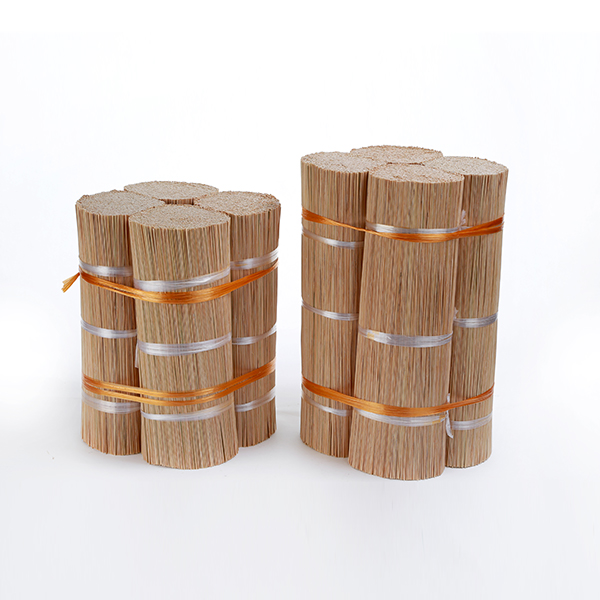
Bamboo sticks for making incense: a traditional method of making incense in the incense industry
Fragrance not only nourishes the nose with its fragrance, but also nourishes the mind, nurtures life, and opens up the mind and wisdom. This is a principle of traditional fragrance making techniques. It is precisely because of adhering to this concept that traditional fragrances have not only become aromatic substances, but also become medicines for promoting wisdom and health. Throughout the long historical period from the Qin and Han dynasties to the Ming and Qing dynasties, they have won widespread popularity in society.
Comparatively speaking, the modern fragrance making process based on chemical technology mainly relies on the aroma of the scent, rather than the health promoting function of the fragrance. This concept affects various aspects of fragrance making. For example, in order to improve production power, reduce material costs, and beautify the appearance of fragrances, many chemical preparations, including chemically synthesized fragrances, are used, and many purely industrialized production methods that are considered harmful to fragrances in traditional processes are adopted.
Regarding the production of incense, ancient China has already formed a complete set of theories that are in line with traditional Chinese medicine and Taoist external pill theory. There is a very mature and perfect craftsmanship system, which is also an inseparable part of China's traditional civilization. There is a rigorous and effective set of methods and standards in the establishment of fragrance formulas, the use of spices, compatibility and counterfeiting, and the production process.
It can be said that traditional fragrance making techniques seek to nourish the mind with fragrance, while modern fragrance making techniques seek to nourish the nose with fragrance. The difference between the two types of fragrances is very obvious.
To make traditional incense, the first step is to summarize and consider the use, aroma type, grade and other elements of the incense, and then select spices or medicinal materials according to these fundamental requirements, and mix them according to the requirements of Jun, Chen, Zuo, and Fu. Only when the ruler, minister, assistant, and helper are in their respective positions can different spices fully display their properties. Fragrances such as yamen, xinxiang, gongxiang, hangxiang, and healing incense each have their own principles and methods, but fundamentally they are determined based on the deduction of the Five Elements, Six Qi, Five Elements, and Heavenly Stems and Earthly Branches to determine the ingredients for the ruler, minister, assistant, and support.
Nowadays, it is common to see single item incense such as sandalwood on the market, so many people mistakenly believe that this type of single item incense is the main body of traditional incense, which is a big misunderstanding. Just as a single traditional Chinese medicinal herb, even if precious, is not necessarily a good medicine, a good spice is not necessarily a good fragrance. For example, regarding sandalwood, ancient people have clearly stated: "When sandalwood is burned alone, it is easy to float and form on the surface of the air. Over time, it can make the gods uneasy
In fact, as early as the Han Dynasty, ancient people had already realized the constraints of single aroma and developed the concept of spice compatibility, and began to use a combination of multiple spices to form a fragrance. From the "Four point Incense Burner" in the early Western Han Dynasty, it can be seen that the fragrance of Hexiang was already about to emerge at that time. After the Han Dynasty, the level of spice compatibility continued to improve, and the variety of fragrance formulas became increasingly abundant. Until the Ming and Qing Dynasties, blended fragrances remained the mainstream of traditional fragrances. It is only in modern times that the decline of fragrant civilization has led to the current situation of regression.
Traditional fragrances are not only highly refined in terms of spice compatibility, but also have strict requirements for the counterfeiting of spices. "If it is not enough, the effect is difficult to achieve, and if it is too much, the flavor will be lost." Whether the counterfeiting is appropriate or not directly affects the quality of the fragrance. The counterfeiting of spices has similarities with the counterfeiting of traditional Chinese medicine, but there are also many differences. The same spice is often counterfeited differently when used in different fragrances. Overall, the purpose of counterfeiting fragrant materials is twofold: firstly, to remove impurities and facilitate their use; secondly, to guide the flow and treat the flow, and to regulate their medicinal properties. Appropriate counterfeiting can enhance the medicinal properties of fragrant materials, fully unleash their effectiveness, and eliminate potential toxic side effects; In addition, specific counterfeiting methods can be used to alter the medicinal properties of fragrant materials according to compatibility requirements
Article source: Fragrant bamboo stickshttp://www.qianzhuhang.com
-
10-30
What should I do if bamboo sticks get moldy in humid weather?
According to natural bamboo raw materials, it is very easy to mold during humid weather and climate, especially during the spring, summer, and dry seasons. Continuous rainy weather for several days in
-
10-29
What are the meanings of the number of sticks used to make incense sticks?
The number of incense sticks for worshipping gods and Buddhas is generally one or three, and can be adjusted according to special needs, with a maximum of 108 sticks of incense sticks. Its significanc
-
10-28
Xiangxin Factory teaches you how to judge the quality of bamboo stick incense
Bamboo stick incense is a fragrance we often use, but many people don't know how to judge the quality of bamboo stick incense when buying it. For this reason, the incense stick factory teaches you how
-
10-27
What other types of fragrances are there besides bamboo stick fragrance?
At present, the hygiene incense in China can be classified into four categories: "stick incense and tower incense that southerners like to burn" and "string incense and pan incense that northerners li