
The traditional process of making fragrant bamboo sticks
In summary, it mainly includes processes such as preparation, steaming, boiling, frying, roasting, baking, grinding, and shaping.
Repair system
That is, picking, kneading, sieving, and drying spices to remove impurities, and then cutting and destroying them.
Steaming material
Use steam or water to heat spices, and the temperature and frequency of steaming should be determined according to the needs. This method can transform spices from raw to ripe, and also separate fragrant materials to regulate their medicinal properties.
Cooking ingredients
Soak it in clean water or with additives (honey, pear juice, wine) to remove its odor and increase its viscosity. Some spices are boiled in charcoal water, wine, or rice swill until the water is dry and the yellow gas is emitted before frying.
Cannon material
Stir fry quickly over high heat, or add Pu Huang Fen and other ingredients to stir fry. The difference in heat between frying and stir frying lies in the use of high heat. For frying, use high heat, while for stir frying and grilling, use low heat.
Stir fried ingredients
When stir frying spices, some should be cooked over high heat until they turn yellow, while others should be roasted. The method of frying sandalwood is to select the right sandalwood ingredients, make them into rice grains, and then stir fry over low heat until the smoke turns purple and the fishy smell is eliminated.
Grilled material
Mix liquid ingredients with spices and stir fry until the ingredients penetrate into the spices.
baking
Put the roasted spices into a ceramic container, then roast them until they are completely dry and destroyed.
grinding
Grind the destroyed spices with water, and then let the slurry settle to make the spices more delicate.
forming
After grinding, the spices are naturally exposed to sunlight and deposited into a paste, which is then placed in a sealed wooden barrel. The barrel is covered with a wooden lid and pressed downwards. There are drilled small holes at the bottom of the barrel, and under the pressure effect, the round shaped fragrant clay will continuously be squeezed out from the holes. After shaping, it is exposed to sunlight; As for the molding methods of pan incense, tower incense, and pillar incense, they are made by injection molding with molds.
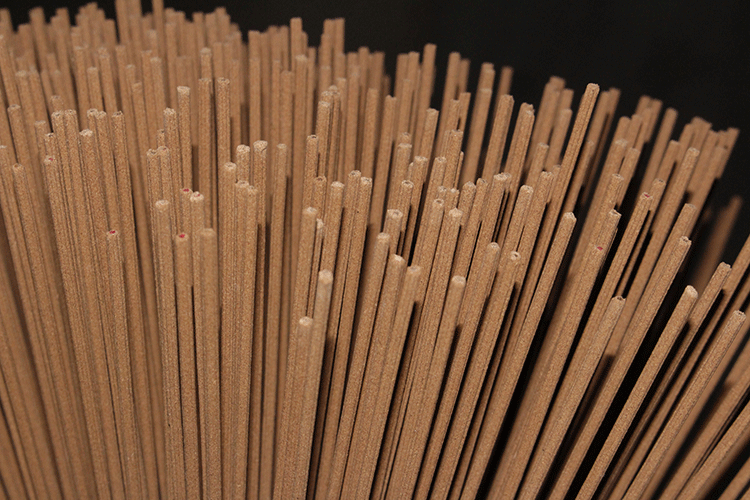
The production process of Buddhist incense is to first make incense bones (also boneless Buddhist incense), which are often made of bamboo sticks and usually dyed. The processing method is the same as before, except for grinding without mixing water. In the ground powder, a certain amount of wood chips are added to facilitate incineration. Two thirds of the fragrant bone is covered with elm bark water containing gum, and then topped with fragrant powder. Repeat this process several times to evenly adhere the fragrant powder to the bone, and dry it with a curtain.
incense making
At present, most of the sanitary perfumes sold are made from elm bark and wood powder by increasing essence, pigments and adhesives according to their share. They belong to the modern process of fragrance making, and the taste and quality of the fragrance cannot be compared with the traditional fragrance making.
The origin of traditional fragrance making, especially the "blended fragrance" mainly composed of animal and plant spices, is unknown, but we cannot forget the handmade research and development of our ancestors.
Article source: Fragrant bamboo stickshttp://www.qianzhuhang.com
-
10-30
What should I do if bamboo sticks get moldy in humid weather?
According to natural bamboo raw materials, it is very easy to mold during humid weather and climate, especially during the spring, summer, and dry seasons. Continuous rainy weather for several days in
-
10-29
What are the meanings of the number of sticks used to make incense sticks?
The number of incense sticks for worshipping gods and Buddhas is generally one or three, and can be adjusted according to special needs, with a maximum of 108 sticks of incense sticks. Its significanc
-
10-28
Xiangxin Factory teaches you how to judge the quality of bamboo stick incense
Bamboo stick incense is a fragrance we often use, but many people don't know how to judge the quality of bamboo stick incense when buying it. For this reason, the incense stick factory teaches you how
-
10-27
What other types of fragrances are there besides bamboo stick fragrance?
At present, the hygiene incense in China can be classified into four categories: "stick incense and tower incense that southerners like to burn" and "string incense and pan incense that northerners li