
The production process of traditional Buddhist incense
The ancients discovered that any type of spice has the effects of refreshing and calming the mind, so the history of incense burning in China has been over 3000 years, and China can be considered one of the earliest countries in the world to process and use spices. Buddhist incense is a fragrance made from tree bark, resin, roots, and other materials that are rich in memories
For Buddhist incense made from spices, its advantages are clear and distinct: firstly, it can remove impurities and beautify the environment; Two, to refresh the mind and cultivate emotions; Three scents to deodorize and purify the body and mind
Next, let's briefly understand the process of traditional Buddhist incense
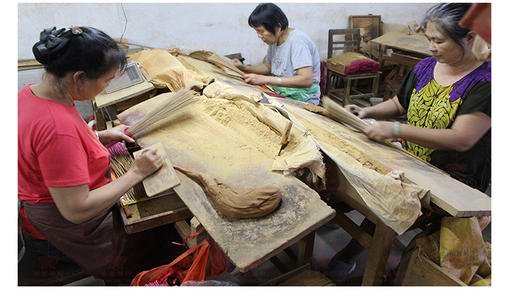
1、 Preparation of raw materials
Fragrance medicine: It is necessary to summarize and consider the use, fragrance type, grade, etc. of fragrance. Generally, literati and scholars use Zelan, Huilan, Jiaoshu, Guishu, Artemisia, Yujin, Yunxiang, etc; Palace official incense and Buddhist incense include agarwood, musk, dragon's brain incense, dragon's saliva incense, etc; Taoism, on the other hand, tends to choose fragrant herbs with unique qualities such as Lingling Xiang, Anxin Xiang, and Jiangzhen Xiang
Taking sandalwood as an example, it is necessary to first make it with clear tea or Yunnan tea, air dry it, and then stir fry it; According to the formula, mix and grind it into a powder, which is called fragrant powder
2、 And materials
Nowadays, it is common to use a mixer to mix raw materials. Grind fragrant herbs, wood powder, etc. are added to the mixer, and water is added in proportion. When adding water, the amount of water should be calculated and added in one go. If water is added during mixing, it will affect the durability and smoothness of the fragrance. The mixing time is generally 20 minutes
3、 Forming
Put the mixed material into the compactor to restrict the material blocks. Generally, the compacts should be evenly and densely packed
Place the pressed material block into the extruder and produce fragrant strips of different thicknesses according to the size of the mold diameter
Generally, the incense sticks produced by Xiangluo may be uneven in length or broken, so it is necessary to repair the sticks
If you need to make incense plates, you need to use specialized equipment to place two incense plates together, neatly and steadily on the incense sticks
4、 Exposure to sunlight
Generally, pan incense does not need to be exposed to direct sunlight. It can be dried in the shade in a place without sunlight. For string incense, it needs to be exposed to direct sunlight to gradually dry the sticks, and then boxed
Article source: Xiangxin Factoryhttp://www.qianzhuhang.com
-
10-30
What should I do if bamboo sticks get moldy in humid weather?
According to natural bamboo raw materials, it is very easy to mold during humid weather and climate, especially during the spring, summer, and dry seasons. Continuous rainy weather for several days in
-
10-29
What are the meanings of the number of sticks used to make incense sticks?
The number of incense sticks for worshipping gods and Buddhas is generally one or three, and can be adjusted according to special needs, with a maximum of 108 sticks of incense sticks. Its significanc
-
10-28
Xiangxin Factory teaches you how to judge the quality of bamboo stick incense
Bamboo stick incense is a fragrance we often use, but many people don't know how to judge the quality of bamboo stick incense when buying it. For this reason, the incense stick factory teaches you how
-
10-27
What other types of fragrances are there besides bamboo stick fragrance?
At present, the hygiene incense in China can be classified into four categories: "stick incense and tower incense that southerners like to burn" and "string incense and pan incense that northerners li